<?xml version="1.0" encoding="utf-8"?><feed xmlns="http://www.w3.org/2005/Atom" ><generator uri="https://jekyllrb.com/" version="4.3.4">Jekyll</generator><link href="https://chem-bla-ics.linkedchemistry.info/feed/by_tag/llm.xml" rel="self" type="application/atom+xml" /><link href="https://chem-bla-ics.linkedchemistry.info/" rel="alternate" type="text/html" /><updated>2026-10-03T09:52:33+00:00</updated><id>https://chem-bla-ics.linkedchemistry.info/feed/by_tag/llm.xml</id><title type="html">chem-bla-ics</title><subtitle>Chemblaics (pronounced chem-bla-ics) is the science that uses open science and computers to solve problems in chemistry, biochemistry and related fields.</subtitle><author><name>Egon Willighagen</name></author><entry><title type="html">New paper: “ToxTempAssistant: using large language models to standardise cell-based toxicological test method descriptions”</title><link href="https://chem-bla-ics.linkedchemistry.info/2026/10/03/new-paper-toxtempassistant-using-large-language-models-to-standardise-cell-based-toxicological-test-method-descriptions.html" rel="alternate" type="text/html" title="New paper: “ToxTempAssistant: using large language models to standardise cell-based toxicological test method descriptions”" /><published>2026-10-03T00:00:00+00:00</published><updated>2026-10-03T00:00:00+00:00</updated><id>https://chem-bla-ics.linkedchemistry.info/2026/10/03/new-paper-toxtempassistant-using-large-language-models-to-standardise-cell-based-toxicological-test-method-descriptions</id><content type="html" xml:base="https://chem-bla-ics.linkedchemistry.info/2026/10/03/new-paper-toxtempassistant-using-large-language-models-to-standardise-cell-based-toxicological-test-method-descriptions.html"><![CDATA[<p><a href="https://orcid.org/0009-0005-3680-0645">Jente Houweling</a> published her first PhD thesis chapter earlier this year:
“ToxTempAssistant: using large language models to standardise cell-based toxicological test method descriptions”
(doi:<a href="https://doi.org/10.1080/2833373X.2026.2638036">10.1080/2833373X.2026.2638036</a>). So far, I have been blogging about
many of the articles on which I am (co-)author. To put it in context. To reflect on the work. I have been postponing
writing about this paper because there is a lot to reflect on. I will pick out two things. First, I look at the use
of AI. The second is the unique, innovative publishing model of the journal where the article was published.
If you want to just see it in action, ToxTempAssistant is <a href="https://toxtempassistant.vhp4safety.nl/">running</a>
on the Virtual Human Platform for safety assessment.</p>

<p>Before we go there, just a quick note on what ToxTemps are and ToxTempAssistent actually is:</p>

<blockquote>
  <p>The ToxTemp template, based on OECD Guidance Document 211, standardises reporting for cell-based NAMs. However,
completing its 77 questions constitutes a substantial bottleneck. The aim of this study is to introduce ToxTempAssistant,
a Large Language Model (LLM)-assisted web tool that supports toxicologists in drafting ToxTemp documents based on
user-supplied context documents. This study quantifies the tool’s baseline performance under controlled conditions.
ToxTempAssistant uses grounded, per-question prompting with mandatory source attribution.</p>
</blockquote>

<h2 id="the-llm-aspects">The LLM aspects</h2>

<p>AI is very old. Arguably, <a href="https://chem-bla-ics.linkedchemistry.info/2009/05/04/thesis-and-copyright-transfer.html">my PhD thesis</a>
had this as key topic, though I preferred to use to term chemometric or machine learning.
Critical thinking has been essential to this field for a long time, and much of the PhD thesis is actually
about critically assessing the performance of the methods used in the thesis. There is decades of research
how you do this. Sadly, when it comes to Large Language Models (LLMs), these are not routinely used.</p>

<p>LLMs are indeed something new. I have seen <a href="https://en.wikipedia.org/wiki/Natural_language_processing">natural language processing</a>
research when I was Cambridge with Peter Murray-Rust. The current LLMs are different, less deterministic, more probabilistic.
From a chemometrics perspective, that makes sense. Language is complex, and not so deterministic in itself. Moreover,
when representing words, sentences as numbers, you can integrate any resource (think data tables, images, etc). Even more,
digital representation was even more the central theme of my PhD thesis.</p>

<p>But because of the nature of the method, the nature of how the commercial, better known models are trained (and the
impact on the notion of copyright), the impact on the <a href="https://en.wikipedia.org/wiki/Climate_crisis">climate emergency</a>,
the black box that these LLMs often are, there are so many technical, scientific, and ethical reasons to stay away from them.</p>

<p>You can write books about that. Literally (I did not read them yet):</p>

<ul>
  <li><a href="https://en.wikipedia.org/wiki/The_Nerd_Reich">The Nerd Reich</a></li>
  <li><a href="https://en.wikipedia.org/wiki/The_AI_Con">The AI Con</a></li>
</ul>

<p>(I have the feeling I am missing one title I wanted to highlight. If I remember, I will add it.)</p>

<p>And more <a href="https://www.goodreads.com/shelf/show/ai-critique">here</a> and <a href="https://womeninaiethics.org/ai-ethics-book-list-for-2024/">here</a>.
And I am looking forward to reading <em>Deep Unlearning: The Rise of AI and the Radicalization of a Tech Idealist</em>.
Also, I recommend at least following <a href="http://dair-community.social/@timnitGebru">Timnit Gebru</a> and
<a href="https://dair-community.social/@emilymbender">Emily Bender</a>.</p>

<p>A year ago, I signed the <a href="https://chem-bla-ics.linkedchemistry.info/2025/08/18/ai-technologies-in-academia.html">Open Letter: Stop the Uncritical Adoption of AI Technologies in Academia</a>,
now signed by more than 2,000 people (it is <a href="https://openletter.earth/open-letter-stop-the-uncritical-adoption-of-ai-technologies-in-academia-b65bba1e">not too late</a>).</p>

<p>So, with all these things mind, I am happy that Jente did critically adopt LLMs in her work. The paper includes
various experiments to explore the impact of various model parameters on generating nonsense. She also explored
to use of alternative LLMs platforms, opening the option that some day it runs on other, more ethical platforms.
ToxTempAssistant, moreover, limits the material it takes information from, from a limited set of sources, provided
by the users. Of course, the model itself is still training on resources with questionable provenance.</p>

<p>Jente’s paper describes the use of positive and negative controls to put the performance in perspective.
In doing so, the paper formalizes how to evaluate the use of LLMs in situations where the LLM is used
to summarize other reports, a common thing to do. This allows us to monitor the impact of, for example,
new LLM releases.</p>

<p>The results are promising and various independent projects have shown interest in adoption. The ToxTemp
reports are important for safety assessment: they provide essential context to experimental results and
as such essential to the FAIR-ness of toxicology data.</p>

<h2 id="open-peer-review">Open Peer Review</h2>

<p>The ToxTempAssistant paper is published in the relatively new journal <a href="https://www.tandfonline.com/journals/tebt20">Evidence-Based Toxicology</a> (EBT):</p>

<blockquote>
  <p>Evidence-Based Toxicology is a broad-focus, gold open-access journal, created to support the use of open science practices and
evidence-based methods in toxicology and environmental health.</p>
</blockquote>

<p>So, CC-BY license (gold open access) and support for Open Science. And Open Peer Review, as we will see. Also,
I understand it is not a diamond open access journal, so expect APCs.</p>

<p>The journal has <a href="https://zenodo.org/communities/ebt/records">a community on Zenodo</a> for preprints and peer-reviews.
I think this is a really nice choice. Of course, a journal specific preprint server has downsides too. For example,
if it gets rejected from EBT, do you use the EBT preprint server when submitting to another journal? Do you upload
a new version (after all, you should address some of the comments why it was rejected) to another preprint server?</p>

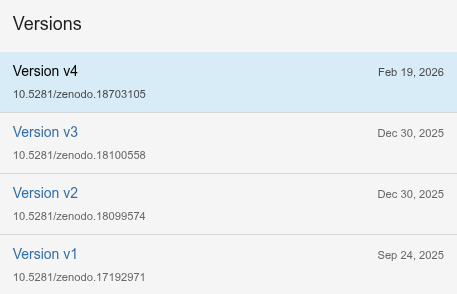
<p>The EBT preprint gets a record and revisions are uploaded as new versions to the same Zenodo record
(doi<a href="https://doi.org/10.5281/zenodo.17192970">10.5281/zenodo.17192970</a>):</p>

<p><img src="/assets/images/ebt_preprint_tta.png" alt="" /></p>

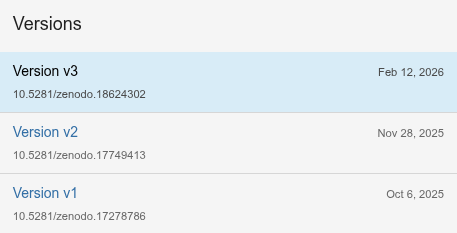
<p>But because EBT uses open peer review, there is a parallel Zenodo entry with the reviews
(doi<a href="https://doi.org/10.5281/zenodo.17278785">10.5281/zenodo.17278785</a>):</p>

<p><img src="/assets/images/ebt_preprint_tta_reviews.png" alt="" /></p>

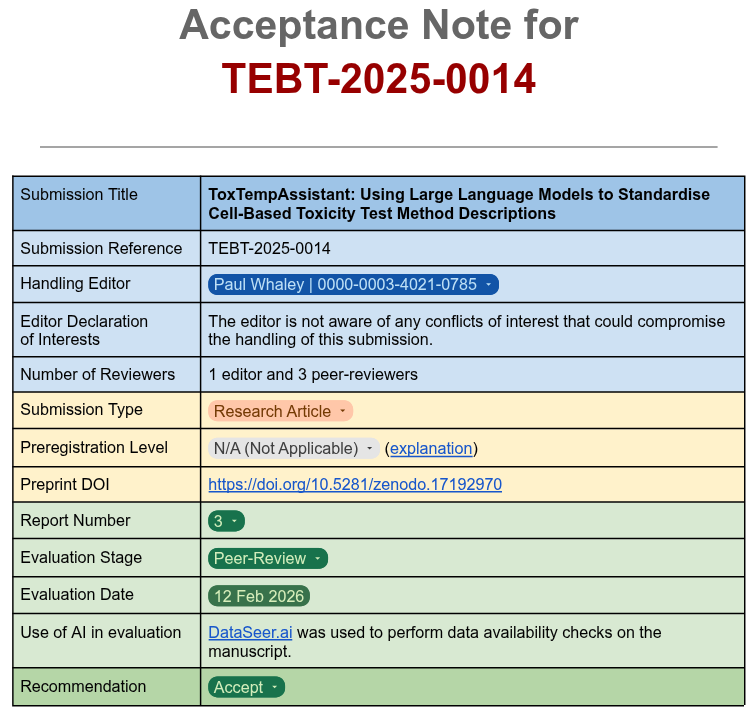
<p>The last version here is the acceptance notice:</p>

<p><img src="/assets/images/ebt_preprint_tta_acceptance.png" alt="" /></p>

<p>One of the reviewer suggestions was to use the TRIPOD-LLM template
(doi:<a href="https://doi.org/10.1038/s41591-024-03425-5">10.1038/s41591-024-03425-5</a>), which was included in a
later revision. That made a lot of sense and is a nice example how the journal actively works
on applying open science ideas. The journal webpage writes:</p>

<blockquote>
  <p>We define “open science” as the set of practices aimed at improving the transparency, validity,
reproducibility, and accessibility of scientific research, while promoting equality of
opportunity to participate in and benefit from the products of said research.</p>
</blockquote>

<p>One comment here is that the template asks on what page that point of the checklist is discussed
in the article. That is nice, but links it directly to the revision of the manuscript that
form applies too, but that is not reported in the template. Not ideal. Then again, the point
is the checking, so maybe not a big deal.</p>

<p>Another comment is that it seems the journal website’s page for the article does not seem to actually
link to the preprints nor the peer-review reports (or acceptance note). So, in time, these
open science aspects of this article will likely get lost in time. Who will find those reports
if the article does not cite them? This will require Taylor&amp;Francis to modernize the publishing
model, and I sincerely doubt that that will ever happen.</p>

<p>Prof. <a href="https://orcid.org/0000-0002-6465-4498">Anne Kienhuis</a>, one of the co-authors, suggested
this journal lead by Prof. <a href="https://orcid.org/0000-0003-4021-0785">Paul Whaley</a>.
And I am happy to have seen this new approach in action and like to thank Paul for pushing for
these innovations. I recommend trying it yourself for your next toxicology work.</p>]]></content><author><name>Egon Willighagen</name></author><category term="fair" /><category term="llm" /><category term="vhp4safety" /><category term="mycito:discusses:10.1080/2833373X.2026.2638036" /><category term="cito:citesForInformation:10.14573/altex.1909271" /><category term="openscience" /><category term="cito:citesAsEvidence:10.5281/zenodo.17278785" /><category term="cito:citesAsEvidence:10.5281/zenodo.17192970" /><category term="cito:discusses:10.1038/s41591-024-03425-5" /><summary type="html"><![CDATA[Jente Houweling published her first PhD thesis chapter earlier this year: “ToxTempAssistant: using large language models to standardise cell-based toxicological test method descriptions” (doi:10.1080/2833373X.2026.2638036). So far, I have been blogging about many of the articles on which I am (co-)author. To put it in context. To reflect on the work. I have been postponing writing about this paper because there is a lot to reflect on. I will pick out two things. First, I look at the use of AI. The second is the unique, innovative publishing model of the journal where the article was published. If you want to just see it in action, ToxTempAssistant is running on the Virtual Human Platform for safety assessment.]]></summary><media:thumbnail xmlns:media="http://search.yahoo.com/mrss/" url="https://chem-bla-ics.linkedchemistry.info/assets/images/ebt_preprint_tta_acceptance.png" /><media:content medium="image" url="https://chem-bla-ics.linkedchemistry.info/assets/images/ebt_preprint_tta_acceptance.png" xmlns:media="http://search.yahoo.com/mrss/" /></entry><entry><title type="html">AI Technologies in Academia</title><link href="https://chem-bla-ics.linkedchemistry.info/2025/08/18/ai-technologies-in-academia.html" rel="alternate" type="text/html" title="AI Technologies in Academia" /><published>2025-08-18T00:00:00+00:00</published><updated>2025-08-18T00:00:00+00:00</updated><id>https://chem-bla-ics.linkedchemistry.info/2025/08/18/ai-technologies-in-academia</id><content type="html" xml:base="https://chem-bla-ics.linkedchemistry.info/2025/08/18/ai-technologies-in-academia.html"><![CDATA[<p>I have had the <a href="https://openletter.earth/open-letter-stop-the-uncritical-adoption-of-ai-technologies-in-academia-b65bba1e">Open Letter: Stop the Uncritical Adoption of AI Technologies in Academia</a>
from June 27 open for some time now. I thought I wanted to sign it, but got stuck on the first paragraphs multiple times:</p>

<blockquote>
  <p>With this letter we take a principled stand against the proliferation of so-called ‘AI’ technologies in universities. As an educational institution,
we cannot condone the uncritical use of AI by students, faculty, or leadership. We also call for reconsidering any direct financial relationships
between Dutch universities and AI companies.The unfettered introduction of AI technology leads to contravention of the spirit of the EU Al act. It
undermines our basic pedagogical values and the principles of scientific integrity. It prevents us from maintaining our standards of independence
and transparency. And most concerning, AI use has been shown to hinder learning and deskill critical thought.</p>
</blockquote>

<p>These few lines contain for me more than 25 years of research and I know the complexities. Before I can co-sign this letter,
I need to understand the details. There is no definition of ‘AI’ here and it mentiones the <a href="https://eur-lex.europa.eu/legal-content/NL/TXT/?uri=CELEX:32024R1689">EU AI Act</a>
(I guess, the letter actually writes “Al” (with an <code class="language-plaintext highlighter-rouge">l</code> of letter) act, I notice now after I read the content in another font),
but I have not read the EU AI Act yet (it is 144 pages of legal text).</p>

<h2 id="the-legal-context-of-the-open-letter">The legal context of the Open Letter</h2>

<p>Let me first say, I am not a lawyer (IANAL). I am not versed in the specific legal definitions of tightly defined and controlled
words.</p>

<p>Reading the <em>EU AI Act</em>, I read a reassuring opening statement (repeated later with more context, links to other laws, etc):</p>

<blockquote>
  <p>to promote the uptake of human centric and trustworthy artificial intelligence (AI) while ensuring a high level of protection
of health, safety, fundamental rights as enshrined in the Charter of Fundamental Rights of the European Union (the ‘Charter’),
including democracy, the rule of law and environmental protection, to protect against the harmful effects of AI systems in the Union</p>
</blockquote>

<p>We clearly see how these things are currently routinely violated.</p>

<blockquote>
  <p>This Regulation does not apply to AI systems or AI models, including their output, specifically developed and put into service
for the sole purpose of scientific research and development.</p>
</blockquote>

<p>In Dutch this is officially translated to “wetenschappelijk onderzoek”, so <em>scientific research</em> seems to be legally
including humanites, etc, and not limited to natural sciences [citation needed].</p>

<p>The EU AI Act also outlines a definition of “AI”, leaning towards machine learning, but the border between deterministic,
rule-based algorithms and machine-learned patters for predictions remains a bit vague to me. But I can live with it.</p>

<p>The Open Letter’s <em>contravention of the spirit of the EU Al act</em> gets context here too. It has to be the <em>spirit</em>,
because the law does not apply to academia. Good, clarified. The Letter continues with:</p>

<blockquote>
  <p>It undermines our basic pedagogical values and the principles of scientific integrity.
It prevents us from maintaining our standards of independence and transparency. And most concerning, AI use has been
shown to hinder learning and deskill critical thought.</p>
</blockquote>

<p>Yes, that clearly links to the EU AI Act’s protection of rights. Maybe on purpose and maybe there are legal reasons
to not explicitly list them, are the international human rights, which includes rigths to benefit from science,
but I think this is still in the spirit of the EU AI Act. And if AI fetters our ability to learn (yes, there
is scientific evidence for that [citation needed]), then it violates the EU AI Act (IANAL).</p>

<h2 id="what-the-open-letter-expects">What the Open Letter expects</h2>

<p>The next part of the Open Letter calls to what the signers expect from our universities. I will will reflect on each of them.</p>

<blockquote>
  <p><strong>Resist the introduction of AI in our own software systems</strong>, from Microsoft to OpenAI to Apple. It is not in our interests
to let our processes be corrupted and give away our data to be used to train models that are not only useless to us, but
also harmful.</p>
</blockquote>

<p>The intrinsic problem and why I think it is fair to call out these companies, is, as the letter explains, there
is an clear conflict of interest. The goal of companies is to make profit (and in a Western world, as much
as possible), and not any of the human or scientific needs. In this respect, companies like Elsevier
could just as well have mentioned too (see e.g. <a href="https://irisvanrooijcogsci.com/2025/08/12/ai-slop-and-the-destruction-of-knowledge/">this post by Prof. Van Rooij</a>,
actually 2nd signature on the letter).</p>

<blockquote>
  <p><strong>Ban AI use in the classroom</strong> for student assignments, in the same way we ban essay mills and other forms
of plagiarism. Students must be protected from de-skilling and allowed space and time to perform their
assignments themselves.</p>
</blockquote>

<p>About a year ago, I was pleasently surprised by the depth of discussion at Maastricht University on how and when
to use AI, and by default not. This one is really complicated and it matters when and how the AI is used.
After all, and the spirit of the EU AI Act expects us to use AI in research (to trigger innovation). So,
I cannot agree with the literal statement, but I fully agree with the spirit. Particularly combined with
the clear “Stop the Uncritical Adoption of AI Technologies in Academia” of the title of the Open Letter.</p>

<p>I read this line like this, AI in the classroom must have a purpose that aligns with the EU AI Act.
That means, use for writing assays, reports, it must not be used. I am old enough that remember the
academic discussions (at Radboud University) about writing and the clear hesitance among scholars
about the use of written assignments: “I want to test their scientific knowledge and reasoning skills,
not their ability to write narratives”. And LLMs, like ChatGPT but also the European, more open variants,
they write narratives, so the written report and assay is no longer a valid way to assess a student’s
scientific learning progress.</p>

<p>So, alternatively, we should very carefully and scientifically evaluate which forms of assessment
we perform, and banning AI in the classroom may just be distracting from a more fundamental problem.
Anyways… if you continue using writing assignments to test progress in learning, you must ban
use of AI in that process. You must be testing the student, not some piece of software (as a teaching
institute).</p>

<blockquote>
  <p><strong>Cease normalising the AI hype</strong> and the lies which are prevalent in the technology industry’s framing of
these technologies. The technologies do not have the advertised capacities and their adoption puts students
and academics at risk of violating ethical, legal, scholarly, and scientific standards of reliability,
sustainability, and safety.</p>
</blockquote>

<p>Sounds like a no brainer. But I too find my own university uncritically promoting AI. Maybe the tested
it well, and just forgot to share that. But hey, scientifical quality goes all ways.</p>

<blockquote>
  <p><strong>Fortify our academic freedom</strong> as university staff to enforce these principles and standards in our
classrooms and our research as well as on the computer systems we are obliged to use as part of our
work. We as academics have the right to our own spaces.</p>
</blockquote>

<p>Again, a no brainer. But important to add. It must be said as it is intrisic part of
<a href="https://recognitionrewards.nl/">Recognition &amp; Rewards</a>. If you cannot guarantee academic freedom,
there there is something seriously wrong with your R&amp;R.</p>

<blockquote>
  <p><strong>Sustain critical thinking on AI</strong> and promote critical engagement with technology on a firm
academic footing. Scholarly discussion must be free from the conflicts of interest caused by
industry funding, and reasoned resistance must always be an option.</p>
</blockquote>

<p>Yeah, this is something that is underestimated. Part of our academic teaching is this critical thinking.
It returns in academic reading (did you already read <em>“What Little Red Riding Hood Can Teach Us about Reading Science”</em>,
doi:<a href="https://uplopen.com/chapters/e/10.1515/9783110782844-010">10.1515/9783110782844-010</a>,
by <a href="https://scholar.google.com/citations?user=0KRmIbcAAAAJ&amp;hl=nl&amp;oi=ao">Monica Gonzalez-Marquez</a> <em>et al.</em>?),
scientific programming, data analysis, and our teaching has been
lacking here. Not just for new AI forms, but also for the old algorihmts. I have seen this, and
scientific literature is riddled with mistakes, just because our peer reviewers are not sufficiently
skilled. This will take effort. I know, it was a major part of
<a href="https://chem-bla-ics.linkedchemistry.info/2008/03/01/todo-april-2nd-defend-my-phd-work.html">my PhD thesis</a>.</p>

<p>Of course, this is exactly why I have been so active in Open Science. Without Open Science,
we cannot work <em>in the spirit</em> of the EU AI Act. It’s nothing new. It’s just that the big money
has found in AI a way to profit at the expense of humans.</p>

<p>So, go read that <a href="https://openletter.earth/open-letter-stop-the-uncritical-adoption-of-ai-technologies-in-academia-b65bba1e">Open Letter</a>
and sign too!</p>]]></content><author><name>Egon Willighagen</name></author><category term="cheminf" /><category term="chemometrics" /><category term="justdoi:10.1515/9783110782844-010" /><category term="openscience" /><category term="llm" /><summary type="html"><![CDATA[I have had the Open Letter: Stop the Uncritical Adoption of AI Technologies in Academia from June 27 open for some time now. I thought I wanted to sign it, but got stuck on the first paragraphs multiple times:]]></summary></entry></feed>